
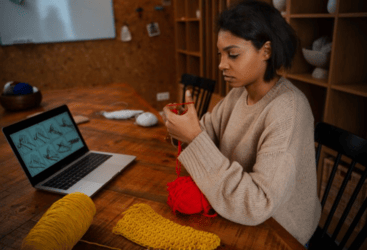
Online courses used to mean spreadsheets, compliance modules, and falling asleep during a recorded lecture. That era is over. Some of the best online learning available right now is in creative and hands-on skills — pottery, sewing, woodworking, illustration, home décor, candle making — taught by people who actually do these things for a living.
If you’ve ever wanted to pick up a craft but didn’t know where to start, an online course is probably the fastest route from “I have no idea what I’m doing” to “I just made a thing and it doesn’t look terrible.”
Here’s where to look.
Skillshare
Skillshare’s creative catalogue is its strongest category by a wide margin. Thousands of classes covering illustration, graphic design, watercolour, calligraphy, sewing, photography, and more. Most classes run 30-90 minutes and are structured as short projects rather than long lectures, which works well for hands-on skills.
- Best for: Visual arts, illustration, graphic design, photography
- Cost: Free trial, then roughly $14/month for Premium
- Format: Video lessons with class projects. Community section for sharing work.
The project-based structure is worth highlighting. You don’t just watch someone paint — you paint alongside them and upload your result. That loop of watching, doing, and sharing is what makes creative learning stick.
Domestika
Less well-known than Skillshare but arguably better for craft-specific courses. Domestika focuses almost entirely on creative disciplines: ceramics, embroidery, bookbinding, natural dyeing, printmaking, floral design. The instructors are working professionals and the production quality is high.
- Best for: Craft-specific skills, textile arts, ceramics, printmaking
- Cost: Individual courses $10-15 (frequent sales)
- Format: Multi-lesson courses with downloadable resources
YouTube (Free)
The obvious one, but it deserves a proper mention because the quality of free creative tutorials on YouTube has gotten genuinely excellent. Channels like Yoga with Adriene (for body-based creative practice), Simone Giertz (for inventive builds), and countless smaller creators in niches from soap making to furniture restoration offer detailed, watchable instruction at no cost.
The trade-off: no structure. YouTube is great for one-off techniques but poor for building a skill from zero to competent. Pair it with a more structured platform for best results.
Creative Lifestyle Blogs as Learning Resources
Not everything needs to be a formal course. Some of the most practical creative instruction lives on blogs run by makers who document their own projects in enough detail that you can follow along.
Sites like TibilisFil take this approach — real projects with honest notes about what worked and what didn’t, materials lists, step-by-step processes. It’s less polished than a Domestika course but often more relatable, because you’re learning from someone who’s figuring things out alongside you rather than demonstrating a perfected technique.
The combination of a structured course for foundations and a blog or community for ongoing inspiration is, in my experience, the most effective way to build a creative skill and actually keep practising it.
Coursera and Udemy (For the Theory Side)
If your creative interest has a technical dimension (colour theory, design principles, architecture basics, materials science) Coursera and Udemy fill that gap. These platforms are stronger on the academic side than the hands-on side, but understanding why design choices work makes your practical output better.
- Coursera offers free audit access to courses from institutions like CalArts, MoMA, and the Rhode Island School of Design. Worth browsing even if you never pay for a certificate.
- Udemy runs perpetual sales where $80 courses drop to $12. The quality varies wildly — read reviews carefully and look for courses with 4.5+ ratings and at least 1,000 reviews.
Picking the Right Format
| If You Want… | Best Platform | Why |
|---|---|---|
| A quick project this weekend | Skillshare | Short, project-based classes |
| A specific craft skill | Domestika | Deep, focused craft courses |
| Free tutorials for a one-off technique | YouTube | Massive free catalogue |
| Design theory and foundations | Coursera (free audit) | University-level content |
| Ongoing practical inspiration | Creative blogs | Real-world project documentation |
The right platform depends on where you are. If you’ve never made anything, start with YouTube or Skillshare to lower the barrier. If you’ve got basics and want depth, Domestika’s individual courses are hard to beat and you can stay motivated with our tips.
Either way, the best time to start learning a creative skill was five years ago. The second best time is right now. If you’re torn between free and paid online courses, our practical guide simplifies that.